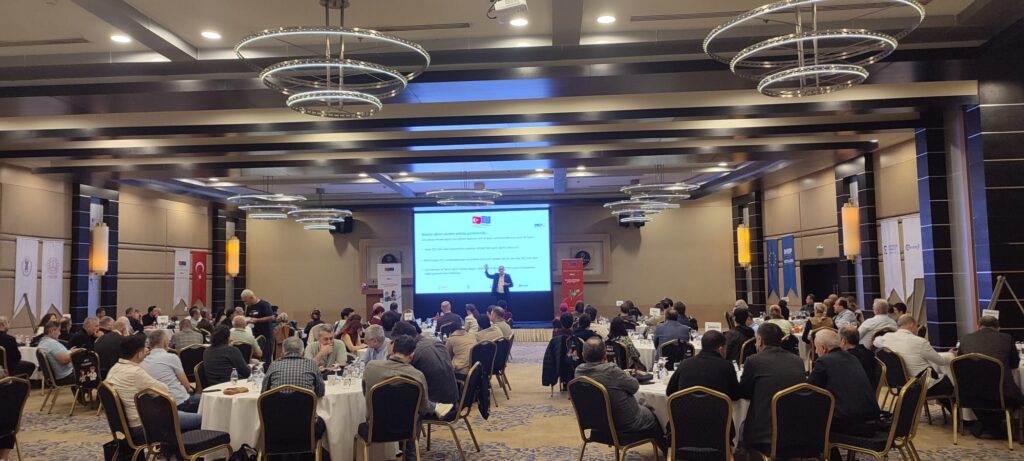
At a workshop held in Konya under VET4JOB-II, representatives of 44 pilot institutions across 14 provinces came together to assess needs and explore sustainable cooperation models to strengthen collaboration between Vocational Training Centres (VTCs) and businesses.
The VTC–Business Cooperation Development Workshop was held in Konya on 21–23 October 2026 under the second phase of the Vocational Education and Training Programme for Employment (VET4JOB-II), funded by the European Union and implemented by Expertise France in cooperation with the Ministry of National Education’s Directorate General for Vocational and Technical Education (MoNE-DGVET) and the Confederation of Turkish Tradesmen and Craftsmen (TESK).
The opening speeches were delivered by Murat Yiğit, Konya Provincial Director of National Education; Balkır Özünlü, VET4JOB-II Programme Coordinator, representing MoNE-DGVTE; Fuat Elvan, Director of EU and External Relations at TESK; and Fatma Özdemir Uluç, VET4JOB-II Team Leader.
The workshop brought together a deputy principal responsible for coordination and a coordinating teacher from each of the 44 VTCs across 14 provinces. Liaison officers from the Provincial Directorates of National Education, as well as representatives of TESK and the Union of Chambers of Tradesmen and Craftsmen (ESOB), also participated. The event provided a platform for sharing experiences and reviewing findings related to the cooperation models developed across different provinces.
Over the three days, participants assessed the current state of cooperation between VTCs and businesses and discussed needs at school, provincial and regional levels. International good practices were examined to identify feasible cooperation models. Participants also worked on the steps required to adapt these models to local conditions, including implementation schedules, roles and responsibilities, and potential risks. On the final day, participants received an update on the VET4JOB Student Work File and matching practices, followed by a question-and-answer session.
Building strong and sustainable relationships between VTCs and businesses is essential to ensuring that school-based education complements vocational learning in the workplace. The workshop aimed to strengthen experience-sharing between institutions, improve cooperation processes and promote practical models that can be implemented in the field. These efforts also support VET4JOB-II’s broader objectives of supporting internationally and temporarily protected individuals and host communities in Türkiye through vocational education, while enhancing opportunities for educational, social and economic integration.